Read Full Text
Executive Order 14388 of February 20, 2026
Continuing the Suspension of Duty-Free De Minimis Treatment for All Countries
Republication
[Editorial Note: Executive Order 14388 was originally published on pages 9433 through 9436 in the issue of Wednesday, February 25, 2026. In that publication, the document did not include the accompanying annex. The corrected document is republished in its entirety with the accompanying annex.]
By the authority vested in me as President by the Constitution and the laws of the United States of America, including the International Emergency Economic Powers Act (50 U.S.C. 1701 et seq.) (IEEPA), the National Emergencies Act (50 U.S.C. 1601 et seq.), section 604 of the Trade Act of 1974, as amended (19 U.S.C. 2483), and section 301 of title 3, United States Code, it is hereby ordered:
Section 1 . Background. In several Executive Orders, including Executive Order 14193 of February 1, 2025 (Imposing Duties To Address the Flow of Illicit Drugs Across Our Northern Border), as amended; Executive Order 14194 of February 1, 2025 (Imposing Duties To Address the Situation at Our Southern Border), as amended; Executive Order 14195 of February 1, 2025 (Imposing Duties To Address the Synthetic Opioid Supply Chain in the People's Republic of China), as amended; Executive Order 14257 of April 2, 2025 (Regulating Imports With a Reciprocal Tariff To Rectify Trade Practices That Contribute to Large and Persistent Annual United States Goods Trade Deficits), as amended; and Executive Order 14324 of July 30, 2025 (Suspending Duty-Free De Minimis Treatment for All Countries), I declared or described national emergencies with respect to unusual and extraordinary threats to the national security, foreign policy, or economy of the United States and took action to deal with those threats, including suspending duty-free de minimis treatment under 19 U.S.C. 1321(a)(2)(C) for certain imports.
As relevant here, in section 3 of Executive Order 14324, I set forth the duty rates applicable to shipments sent to the United States through the international postal network that would otherwise qualify for the de minimis exemption under 19 U.S.C. 1321(a)(2)(C). These duty rates were based on the additional duty rates imposed by Executive Orders issued under IEEPA, including Executive Order 14193, as amended; Executive Order 14194, as amended; Executive Order 14195, as amended; and Executive Order 14257, as amended.
In section 6 of Executive Order 14324, I made clear that the suspension of, or continued suspension of, duty-free de minimis treatment, as detailed in Executive Order 14324, shall not be affected if the additional duties imposed under Executive Order 14193, as amended; Executive Order 14194, as amended; Executive Order 14195, as amended; or Executive Order 14257, as amended, were held to be invalid. I also provided that—should such invalidation occur—duty-free de minimis treatment under 19 U.S.C. 1321(a)(2)(C) would be available for shipments sent through the international postal network only until I received a notification from the Secretary of Commerce (Secretary) that adequate systems were in place to fully and expeditiously process and collect duties applicable to such shipments.
Since the issuance of Executive Order 14324, the conditions outlined in section 6 of Executive Order 14324 have occurred. Also since the issuance of Executive Order 14324, the Secretary has notified me that adequate systems are now in place to collect certain duties applicable to shipments sent through the international postal network that would otherwise be eligible for duty-free de minimis treatment. I also have received additional information and recommendations from various senior officials regarding the suspension of duty-free de minimis treatment.
After considering the information and recommendations these officials have provided to me, among other things, I have determined that it is still necessary and appropriate to suspend duty-free de minimis treatment under 19 U.S.C. 1321(a)(2)(C), including for shipments sent through the international postal network. U.S. Customs and Border Protection (CBP) shall collect duties on shipments sent through the international postal network in accordance with Executive Order 14324, as amended below. CBP shall also continue to take all appropriate action to collect all applicable duties, taxes, fees, exactions, and charges for shipments not sent through the international postal network. In my judgment, these actions are necessary and appropriate to deal with the national emergencies declared in Executive Order 14193, Executive Order 14194, Executive Order 14195, and Executive Order 14257. Each determination is independent of the other and is made only for the purpose of dealing with the respective emergency and not for the purpose of dealing with another emergency.
Sec. 2 . Continuing the Suspension of Duty-Free De Minimis Treatment. Section 2 of Executive Order 14324 is revised to read as follows:
“(a) The duty-free de minimis exemption provided under 19 U.S.C. 1321(a)(2)(C) shall not apply to any shipment of articles not covered by 50 U.S.C. 1702(b), regardless of value, country of origin, mode of transportation, or method of entry. Accordingly, all such shipments, except those sent through the international postal network, shall be subject to all applicable duties, taxes, fees, exactions, and charges. International postal shipments not covered by 50 U.S.C. 1702(b) shall be subject to the duty rates described in section 3 of this order. Entry for all shipments that, prior to the effective date of this order, qualified for the de minimis exemption, shall be filed using an appropriate entry type in the Automated Commercial Environment (ACE) by a party qualified to make such entry—except for shipments sent through the international postal network, which shall be dutiable in accordance with section 3 of this order.
(b) Shipments sent through the international postal network that would otherwise qualify for the de minimis exemption under 19 U.S.C. 1321(a)(2)(C) shall pass free of any duties except those specified in section 3 of this order, and without the preparation of an entry by CBP, until the effective date for the new entry process for postal shipments established by CBP and published in the Federal Register.”
Sec. 3 . Duty Rates for International Postal Shipments. Section 3 of Executive Order 14324 is revised to read as follows:
“(a) Transportation carriers delivering shipments sent to the United States through the international postal network, or other parties if qualified in lieu of such transportation carriers, as approved by CBP, must collect and remit duties to CBP using the methodology described in subsection (b) of this section. Each transportation carrier or other qualified party shall remit duty payment to CBP in accordance with CBP guidance on the requirements and process for remittance.
(b) A duty equal to the rate provided in the Proclamation of February 20, 2026 (Imposing a Temporary Import Surcharge to Address Fundamental International Payments Problems), shall be assessed on the value of each dutiable postal item containing goods entered for consumption. This duty rate shall be assessed until the expiration date of the temporary import surcharge established by the Proclamation of February 20, 2026, or until the effective date of the new entry process for postal shipments established by CBP, whichever date occurs first.
(c) For all international postal shipments subject to the duty rate in the Proclamation of February 20, 2026, in accordance with subsection (b) of this section, the country of origin of the article and its value must be declared to CBP.
(d) Shipments sent through the international postal network that are subject to antidumping and countervailing duties or a quota must continue to be entered under an appropriate entry type in ACE to the extent required by all applicable regulations.”
Sec. 4 . Further Revisions.Executive Order 14324 is further revised by striking section 5 and renumbering sections 6 and 7 as 5 and 6, respectively.
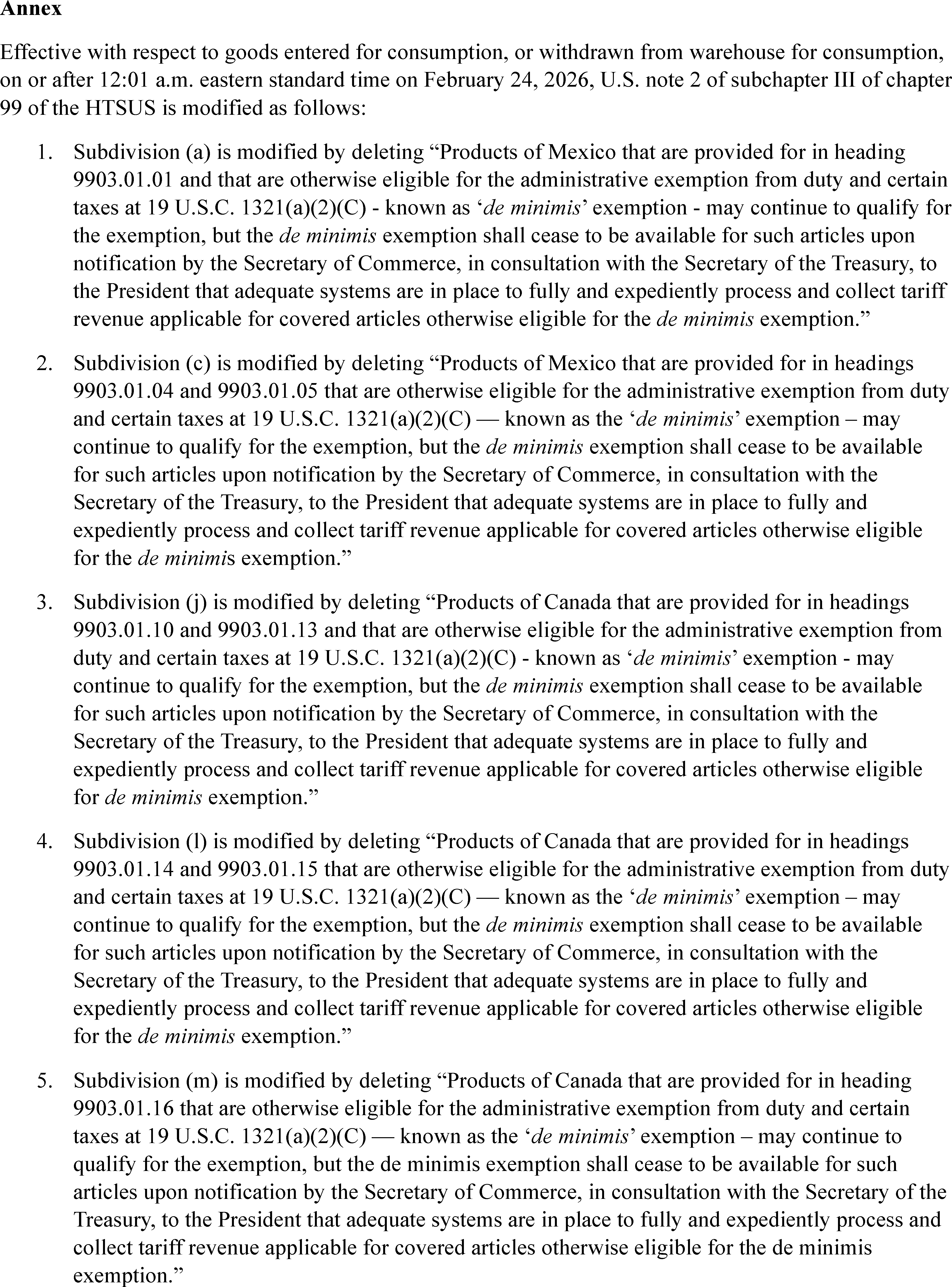
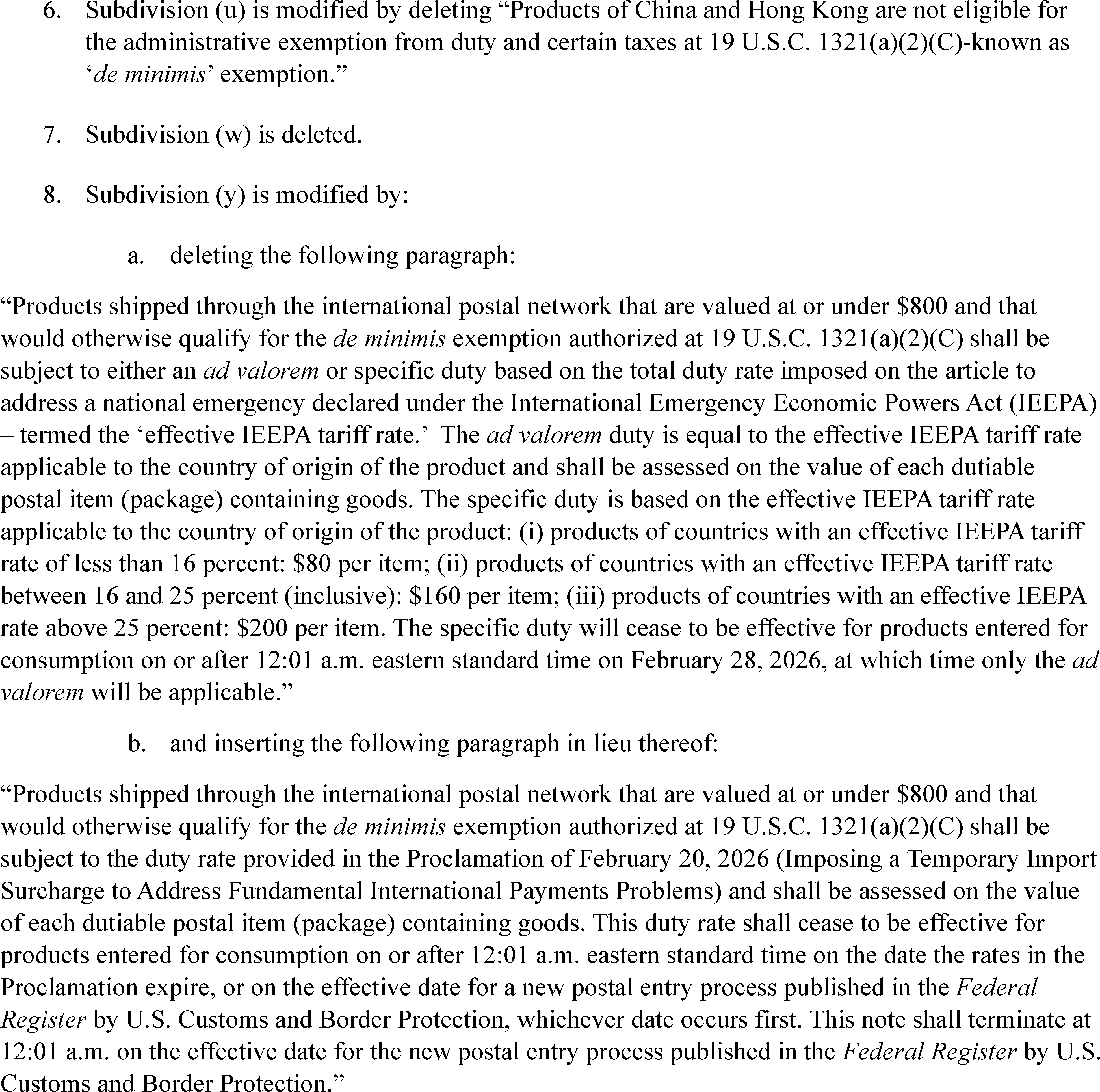
Sec. 5 . Implementation. (a) The modifications to Executive Order 14324 in this order shall be effective with respect to goods entered for consumption, or withdrawn from warehouse for consumption, on or after 12:01 a.m. eastern standard time on February 24, 2026. Additionally, the Harmonized Tariff Schedule of the United States shall be modified as provided in the Annex to this order.
(b) Consistent with applicable law, the Secretary of Homeland Security is directed and authorized to take all necessary actions to implement and effectuate this order—including through temporary suspension or amendment of regulations or through notices in the Federal Register and by adopting rules, regulations, or guidance. The Secretary of Homeland Security may continue to employ all powers that were previously authorized in Executive Order 14324 as may be necessary to implement and effectuate this order.
Sec. 6 . Effect on Prior Actions and Severability. Any provision of previous proclamations and Executive Orders that is inconsistent with this order is superseded to the extent of such inconsistency. If any provision of this order or the application of any provision of this order to any individual or circumstance is held to be invalid, the remainder of this order and the application of its provisions to any other individuals or circumstances shall not be affected.
Sec. 7 . General Provisions. (a) Nothing in this order shall be construed to impair or otherwise affect:
(i) the authority granted by law to an executive department or agency, or the head thereof; or
(ii) the functions of the Director of the Office of Management and Budget relating to budgetary, administrative, or legislative proposals.
(b) This order shall be implemented consistent with applicable law and subject to the availability of appropriations.
(c) This order is not intended to, and does not, create any right or benefit, substantive or procedural, enforceable at law or in equity by any party against the United States, its departments, agencies, or entities, its officers, employees, or agents, or any other person.
(d) The costs for publication of this order shall be borne by the Department of Homeland Security.